Tuesday, June 26, 2012

Standard Chartered KL Marathon 2012

It is strange that although I've been running races since 2008, I have never run a full marathon in the Standard Chartered KL Marathon (SCKLM). I have run quite a number of races in KL, of course, but for shorter distances. If I'm not mistaken, before this, the longest race I've joined in KL was for 30km only. Last year, I ran a half marathon in the SCKLM. But this year, I decided to join the full marathon in the SCKLM. The main reason was because this year I did not run the Borneo International Marathon in May, because I was a member of the organising committee.

About a month ago, I ran the Sundown Marathon in Singapore and I finished in 4:33 in spite of my target to achieve 4:20. I'm not sure why I failed. Maybe it was because of the heavy rain; maybe it was because I couldn't get enough sleep before the race. But it made me think that perhaps I'm just not destined to achieve anywhere near 4 hours for the full marathon within Malaysia or Singapore. So my mission going into the SCKLM was to achieve a 4:20 finish. My personal best (PB) is 4:07. But that was set in Hong Kong at a temperature of about 18C.

My game plan for SCKLM was to run a steady pace throughout the race. However, from my past marathons, I knew that I would slow down significantly beyond the 30km point. So I had planned to run an average pace of 5:40-5:45 mins/km for the first 30km. After that I had expected to slow down to perhaps 6 mins/km or even 7 mins/km, especially since I was aware of the hilly route within the last 6-7km.

I found myself at the starting line at Dataran Merdeka at about 4:15am. It was a huge crowd. But since I was just targetting for a 4:20 finish, I decided that there was not much point to squeeze myself through to the front of the pack.

At the sound of the start horn, it took a minute or two to finally cross the starting line. And even after I've crossed that line, it was still difficult to run. But a few metres later, I was able to start jogging. I think that was a blessing in disguise, as I was able to gradually build up my speed. According to my Garmin, I ran that first km at about 6.5 min/km. But beyond that I was able to maintain about 5:40 mins/km. I felt strong and fresh even after 7-8km, and I had to suppress my inclination to run faster.

It must have been about 5km into the race when I realised that my friend, Judy Liew, was running ahead. She was running beside her boyfriend. Knowing that she's running close to the 4 hour marathon pace, I carefully refrained from overtaking her.

I maintained that pace until 24km - 25km when suddenly Judy stopped at a water station, and I just continued running. A little later, perhaps at Km27, I saw Dr Liaw ahead. As I approached closer to him, I realised that he was slowing down. I overtook him, and a few hundred metres later, when I stopped to drink at a hydration station, I saw him seeking help to nurse his cramps.

As I had expected, I began to feel a bit tired when I was approaching 30km. Just as I was about to turn into the hills, Judy came from behind. As I began to climb the slope, I could feel that my legs were beginning to seize up. Fearing that it would develop into a full-fledged cramp, I had to slow down. At that point, Judy went ahead, and I merely watched her building up the gap between us.

A few kilometres later, at about Km36, I saw my friend Khadeeja cheering from the roadside. She took this photo of me.


For the most part, I try my best to prevent heel striking when I run. In fact, I still do at this point, even though it appears very much like I was heel-striking. But no, when my weight fully came to rest on that foot, it's completely flat on the ground—honest!

That hilly portion of the route was so punishing that I had to slow down to a briskwalk. If I had forced myself to run, I'm sure my legs would have seized up and I would be in big trouble. Judy, however, pushed on bravely over the hills. A short while later, it was time to descend, and I was able to build up speed again.

As we approached the last few kilometres of the race, we merged into the 10km runners and it became quite congested. And then upon turning into the final stretch, we merged with the half marathoners. But the road was wide enough, and I was able to squeeze my way through without much difficulty.

And then to my surprise, my friend, KK Chai, called out my name. I slowed down just a bit for him to take this photo.


Judy was still ahead of me, but I could see she was already very slow. After the race, she told me that she suffered cramps towards the end of the race. But she was still steady as she approached the finish line.

Courtesy of Tey Eng Tiong

I ran the remaining few hundred metres, gaining speed and finishing just a few metres behind Judy. It doesn't really matter how many marathons one had conquered; the ending of a race is always very exhausting! I'm happy that I've managed to do better than 4:20, but unfortunately, I was unable to improve on my PB. Perhaps reason enough to return for another attempt next year?

After collecting my finisher medal and finisher T, I limped slowly to my hotel. And on my way there, I bumped into KK Chai again for the second time that morning. He took this photo of me.


The SCKLM was a well-organised event. The volunteers did a good job. But I stayed at a nearby hotel, so I did not experience the shuttle buses or car park. Neither did I deposit any bags while I run. But I have no reason to doubt that the organiser must have done a good job.

As always, we come to that funny moment after the race. Spending weeks training for the race; spending hard-earned money for the flights, hotel and other expenses; plus the torture of running 42km in the wee hours of the morning with absolutely no chance whatsoever of winning the race, I come home with sore legs and this medal.


Here are the net times of some of my fellow runners from KK:

Full Marathon:
Cornelius: 4:09:22
Judy Liew: 4:10:37
Liaw Yun Haw: 4:30:35
Victoria Jingulam: 6:14:08
Jainuddin Malik: 5:27:41

Half Marathon:
Audrey Tuzan: 2:32:59
Erlinda R B: 2:18:33
Harry Koh: 2:41:35
Nur Abidah Ramlan: 2:37:24
Md Jumat Md Tahir: 2:22:27
Darren Jee: 2:10
Esther Sim: 2:20:56
Patricia Ratnam: 1:58:36

Wednesday, June 20, 2012

The Sadistic Inclination

It's been a long time since the last time I went up Mount Kinabalu. I've been up there 11 times, and it's highly unlikely that I will ever attempt it again. Some time in my late thirties, I developed the altitude sickness, and whenever I went up the mountain, I would suffer terribly, and would take a few days to recover.

It's interesting, however, that whenever I climbed the mountain on my way up to Laban Rata, I'd bump into other mountain climbers who were on their way down. Pretending to be a first-timer mountain climber, I'd ask them how much further to reach Laban Rata. In most cases they would say something like "Almost there!"; or "Just a little bit more", even if it was in fact very much further still to go!

Since I started running races a couple of years ago, I have noticed an interesting tendency about people in general. I run races of varying distances; and more recently, I have done ultra trail marathons up to 100km. In some of those races, when I was exhausted and hoping for the torture to end as soon as possible, I took the trouble to ask the Marshals "How much further?".

The strange reality about asking Route Marshals about remaining distances is that an overwhelming majority of them would deliberately tell you a much shorter distance than it really is. From what I've been through, I'd say easily 80% of them would purposely give you the wrong information—saying something like "Oh! about 3km to go...", when they know that there's actually 5km to go.

In the recent Borneo International Marathon, of which I was involved in overseeing the race routes, I found myself at the tail end of the race route, ie about 1.5km to go to the finish line. And I took the trouble to announce to the runners that they had 1.5km to go. That was the truth. A fellow Route Marshal who stood beside me then said that I should have told the runners that they had only 500 metres to go.

I turned to him and asked why would I lie about the distance? He smiled as if embarrassed by my question, and seemed lost for ideas. But after a while, he said he would lie because he wanted the runners to be encouraged to run faster.

However, in most cases, when these runners run the subsequent 500 metres much faster, they would end up even more exhausted; yet they'd still have 1km to go thereafter. The pain would be even more. In fact, in all likelihood, they may even end up walking to the finish line. I'm convinced that my fellow Route Marshal knew this for a fact, yet he chose to lie about the distance anyway. Immediately we ask ourselves—Why?

Sometimes when faced with a difficult question, there is a tendency to offer the easiest and most logical answer. But the easiest and most logical answer is not necessarily the truth.

There is a psychological significance to this.

Some people do it consciously; others do it sub-consciously. But the truth is that somewhere in all of us there is that sadistic inclination, whether you want to admit it or not. There is that strange craving for seeing or causing pain and suffering upon others. The only question is to what degree. We derive some sort of strange pleasure of seeing others suffer the disappointment and torment of having to continue yet another 1km when they had expected the torture to end.


Wednesday, June 13, 2012

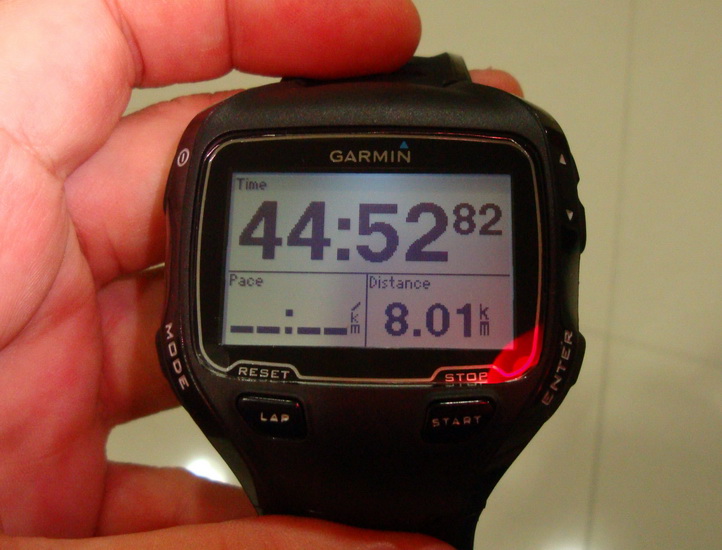
A New Toy—Garmin 910XT

I have a Polar watch which comes together with a footpod and a heart rate monitor (HRM). I used it for some months for training. But after a while I stopped using it. I have come to realise that footpods are inaccurate. In fact, very inaccurate; even when worn by the same runner. For a distance of say 25km to 30km, the margin of errors may be up to a few kilometres. So in the end, I bought a cheap CASIO digital watch.

Then recently I came to know that my friend, Judy Liew, had a Garmin sports watch—the 910XT. Judy is also an avid runner, you see. But for a long time, I noticed that she had a weakness in controlling her starting pace whenever she runs marathons. She had the tendency to run too fast at the beginning, only to burn out too soon and then suffer the consequences at the tail end of the race. This is of course a common problem in many runners. I happen to know a number of runners who can run the half marathon in under 2 hours quite easily, yet when they run the full marathon, they can't do any better than 5 hours!

Well, the 910XT helped Judy during the recent Borneo International Marathon (BIM). She wore it to gauge her pace throughout the race. With it she was able to constantly check her pace. She ended up achieving a new personal best in the BIM and got second in her category.

I didn't really think very much of the Garmin 910XT, until a few weeks ago when I was running together with Judy on a Sunday morning. She wore the 910XT and was able to keep track of our pace. She was also able to tell me the distance covered. Having been through that same route many times before, I realised that the distance recorded by the 910XT was quite accurate. After all, it's relying on the GPS technology.

However, it is kinda bulky, especially when worn by women. Even on a man's hand, it is kinda bulky, but at least it's not too bad, since men's hands are generally bigger than women's. According to Judy, she's not a big fan of all these gadgets for running; she's only using it for the time being. She said in the long run, once she's learned how to control her racing pace, she won't wear anything when running marathons!

"Goodness gracious, Judy!", I exclaimed, "at least have the decency to wear a pair of panties and bras!"

Anyway, to make the long story short—even if that seems to be an impossible thing when it comes to me—I ended up buying a Garmin 910XT myself. It arrived yesterday afternoon by courier service. It came with a chest strap for a heart rate monitor, as well as a bunch of daunting user's manual in many languages. Then other accessories, e.g. the charger, pendrive and some other stuff which I haven't figured out what they are. I think I'll just put them all away in the original box, and one of these days when I have the time, maybe I'll investigate what they're all about.


This morning, I charged the battery and then tried to play around with it a bit. Learned a thing or two, but for the most part, I haven't a clue what more it can do. This evening, I tried it out at the Likas jogging track for a short run. Generally, I'm quite happy with it—it recorded the distance very accurately; and consistently. There was a mention of a "virtual partner", which I'm going to explore in the coming days—or weeks—but it seems very interesting.

According to the information on the box, the 910XT is designed for triathlons. Which means apart from running, it could also be used for swimming and cycling. Maybe by a stroke of miracle I would eventually learn how to use it for the other disciplines, but I doubt that it will be very soon. You see, I had originally planned to complete a triathlon this year, but I have developed a bit of problem with my ears which has rendered swimming out of the question for now. Then again, I've never been any good in swimming as reported here. So it seems like I will save 910XT's feature for swimming for later. But of course I can still explore its use for cycling since that has nothing to do with water getting into my ears.

Incidentally, I will be running the Standard Chartered KL Marathon next Sunday. So I'm gonna run with a new bulky toy on my hand for a change. Of course I won't be able to run as fast as Judy, so I guess I will miss the opportunity to see her running without wearing anything. 

Another week to go, bring it on!


Sunday, June 10, 2012

Time To Tell About Telling Time

About 2 months ago, a friend of mine introduced to me an Indonesian woman who was looking for a job as a maid. I was kinda desperate for one, and I did not quite bother about the interviewing part of the process. She's not young—in fact, she's in her fifties. She had no working experience in her entire life. All these years she's been raising her children in her village in Indonesia; and now that they're all grown up, she reckoned that perhaps she could use her remaining years to earn some money.

She knows a bit of A-B-C, but of course she's not a highly educated woman. The day she arrived at my house, I had to teach her how to lock the doors and how to use the padlocks. She had a curious phobia of my cooking stove. She'd light the stove by reaching out her hand and trying to keep her distance as far as possible, as if afraid that the stove would explode. She said in her village she had never used modern cooking stoves; that she has always been using firewood in her kitchen. That first night, she threw chicken bones into my kitchen sink and I had a tough time to unclog the drain pipe.

Over the next few weeks, we managed to teach her how to use the cooking stove; that frozen stuff should go into the freezer, whereas the vegetables and fruits should go into the lower compartment of the fridge. She also learned how to use the electric kettle. She has even learned how to use the phone. After about a million reminders, she has managed to program her brain to lock all the doors before going to bed at night. She is still essentially a forgetful person, but I suppose I can't expect her to be perfect. However, even if she's not perfect, I'm expecting at least a minimal standard.

She is always having stomach ache, and although I'm not a doctor, I believe it has a lot to do with her inconsistent eating habit. She doesn't really eat at the same time each day. Sometimes she'd eat her breakfast very early; sometimes late; sometimes none at all. Same goes for lunch and dinner. So I've been reminding her to eat her meals at around the same time every day. That, I think, may help to solve her problem. But I'm disappointed that she doesn't heed my advice. She would sometimes eat her lunch at 2pm or even 3pm. She has no sense of time, you see.

Oh well, I guess if that has been her lifestyle in her village, I can't expect her to change overnight just because I tell her to. But then I'm not happy when her ignorance to time is affecting my family. Time and again when we told her to cook lunch or dinner at specific times, she would disobey. At first, I thought she did not understand the instructions. But even after we repeated several times, and in fact we asked her to repeat the instructions, we were satisfied that she understood our instructions. Yet, when it's time for lunch or dinner, she's always either cooking too early or late.

Each time when we ask her why she hasn't started cooking at the specific times according to our instructions, she'd say something like "I forgot", or "I was confused" or "I thought you said...". During her off days, too—when she visits her relatives—she can never get her time right. And I find that very annoying because I'm the one who's supposed to fetch her from the bus stop in the city. She would be either too early or too late.

How should I deal with the problem?

Well, this is a bit ambitious, but I've dug up my digital clock which comes with a time stamp (I usually use it when I'm clerking a treasure hunt). I'm putting this clock in the kitchen and told her to refer to it; for the moment forget about the clock on the wall which is the type with the hour, minute and second hands on it.


Knowledge, as we all know it, is very powerful. But sometimes, we tend to take things for granted. Things such as knowing how to tell the time by looking at the hands of a clock is almost expected of everybody! It's almost embarrassing to admit that we don't know how to do something which the vast majority of the human race knows how to do it. But would you believe it, there may be some people out there who don't know how to tell the time! I know she will never admit it, but let's see if she can remember our instructions with the help of this digital clock.


Thursday, May 31, 2012

Sundown Marathon 2012

A friend of mine, Judy Liew, ran the Sundown Ultra Marathon in Singapore last year. It was a 100km race—seemingly an impossible distance for a footrace with a cutoff time of 18 hours. But when Judy finished it in over 16 hours, my running buddy, Dr Peter, was inspired to try running that distance too this year. Initially, I thought it was a ridiculous distance to attempt; I dreaded the kind of commitment required for the training to conquer the feat. But because Peter wanted to do it, I somehow convinced myself to give it a shot too!

We waited for the launch of the race since last year. But unfortunately, as the months passed, there was no news on the status of the Sundown Ultra Marathon. By early this year, there were rumours flying around, that the Sundown Ultra Marathon has been cancelled; and only the usual marathon (42km) and the other shorter distances would be organised for 2012. I did not lose hope though; I think it must have been around March when I was searching for the Sundown Ultra Marathon online when I stumbled upon the Sundown Marathon instead. Well, it was fast approaching the closing date for registration, so I thought I'd just register first to keep my options open for the time being. And if I should decide to withdraw at the last minute, then at least I would arrange for someone to collect my running vest.

But then after I had registered for the marathon, I felt it would be a waste not to actually run it!

And so, last Friday I arrived in Singapore to run the Sundown Marathon shortly after midnight on Sunday morning. I had of course run quite a number of marathons by now. But I've never been any good at running night marathons. I have run 2 other night races before this, i.e. the Energizer Night Race in March 2010, and the Penang Bridge International Marathon in November 2010. The former (of which I only ran the half marathon) started shortly after sundown, whereas the latter started at 2am. And in both cases, I struggled to finish, let alone achieving personal best (PB) times. Therefore, I approached the Sundown Marathon expecting not to do very well. I have achieved a PB of 4:07:30 for the full marathon in Hong Kong last year. Then in December I did a 4:11 in Macau. Yet I had only targeted a 4:20 for the Sundown Marathon, thinking that that was a modest expectation.

Actually, the Sundown Marathon can be quite misleading—I think it should have been named the Sunrise Marathon as opposed to Sundown. The race was flagged off at 12:30am. I tried to catch some sleep in the afternoon, but my body clock wasn't cooperating. So I spent my time walking to the race venue from my hotel. It turned out that a leisurely walk took up to 20 minutes one way. Then I spent the rest of the afternoon watching reruns on tv in the hotel room.

At about 11:30pm I started out from the hotel to the race venue. As I was approaching the starting line, I was surprised to see the size of the crowd from the overhead bridge above—a sea of people! It reminded me why I don't enjoy the Standard Chartered Marathon Singapore.

After the flag off, I took a few minutes before I finally crossed the starting line. It was so difficult to run in such a crowd. And it took a long time to disperse too. But eventually, at about Km5, the crowd began to thin out a bit, and I was able to run more comfortably. So I started to build up some speed to make up for lost time. But still it wasn't very fast—I did the first 10km in an hour or so; and then the 21km mark in 2:05, which was quite slow considering that I just did a 1:55 half marathon (21km) in Brunei a few weeks ago. I thought I was on target for a 4:20 full marathon. But it wasn't meant to be.

Singapore is warm and humid at night, much the same as in Malaysia. It's strange that I started feeling tired shortly after the halfway mark. In my mind, I knew that it would be a struggle from then on. I kept my pace steady, however, up to about 25km when suddenly it started to drizzle. I was still in the East Coast Park then. I thought the drizzle was quite a relief as I could at least cool down my body. Unfortunately, it developed into a torrential rain with strong winds. All the runners were totally wet. My shoes were filled with water and they felt like they weighed a ton!

As I continued running, my legs grew increasingly exhausted, and by about 35km I could already feel the cramps in my left quads. I compensated my weight with my right leg, but eventually both my quads cramped up. And then the rest of the race was mainly a test of mental strength. I walked for a bit when the cramps were too unbearable; and started to run again when I felt better.

I fought on for what seemed to be an eternity (when one is in pain, time seems to pass extremely slowly), between the rains, and braving some uneven running surfaces and dark sectors of the route, I finally turned into the last stretch of Nicoll Highway again. By then I realised that I had failed to achieve my target of 4:20; not even 4:30. In fact, I eventually finished the race in 4:32:58, way adrift of my target!

One of these days, I want to try to run another night marathon. But I doubt that I would attempt the Sundown Marathon again. The crowd was just too ridiculous. I think perhaps the organiser should seriously consider flagging off the half marathon and full marathon categories at different times; say at least 30 minutes apart; perhaps even up to 60 minutes apart. Maybe that can reduce the size of the crowd at the starting line somehow.

But other than that, it was a well-organised race. Sufficient drink stations, and the distribution of finisher medals and finisher T-shirts at the end very efficiently done. For those who have not experienced a night marathon before, the Sundown Marathon is one which they should try.

Well, back to the drawing board! I need to fine tune my training and running strategy for the Standard Chartered KL Marathon in a few weeks from now. Let's see if I can achieve 4:20 for that race!

Monday, May 14, 2012

Politikus Cabbie

Whenever I travel, I have the habit of striking up conversations with strangers in the street, in the coffee shop, at the train station—in fact, almost anywhere I go to. It's quite interesting to talk to people; you'd be surprised at how much you can learn from these conversations. You get to see things from very different perspectives, through the eyes of people from all walks of life.

Therefore, whenever I ride in a cab, especially when it's a long ride, I take every opportunity to start a conversation with the cabbie. The topic can be about the stressful life in the city; about the traffic jams; and everyday stuff. And inevitably, sometimes politics would also crop up, although it's not my favourite subject.

I was in KL last week on a business trip. When it was time to come home to KK, I took a cab from Mid Valley to the airport—a journey that took about an hour. As we left Mid Valley, we started talking about cab fares, traffic jams and general stuff about how to get a taxi permit in KL. 

But soon after, the cabbie started talking about politics. It wasn't a particularly enjoyable topic, but I can't force others to talk only about the things I like to talk about, you see. Unfortunately, little did I know the cabbie got all too excited until our little conversation soon became a lecture. Before long, he was the only one who's talking, while I was reduced to just listening to him talk. Now many of those who really know me well would find that a bit extraordinary, because quite frankly, usually I'm the one who's doing most of the talking!

Apparently, according on his "survey", except for Melaka and Johor, all the other states in West Malaysia will fall to the Opposition Party in the coming General Election! 100% of the Chinese and at least 50% of the Indians will be voting for the Opposition. And at least half of the Malays will also vote for the Opposition. Heck, doesn't sound like it's gonna be very pleasant for the ruling party!

In the excitement of the political lecture, the cabbie suddenly asked me who I would vote for in the coming General Election. Well, looking at his demeanor, I quickly said "Of course I would vote for the Opposition!" (note the "of course"). I mean it's not a pleasant thought to get kicked out of the cab in the middle of nowhere, and then missing my flight home. He sighed a big relief upon hearing my answer—as if satisfied that he had successfully convinced yet another passenger to vote for the Opposition.

The truth is that I still can't make up my mind up to now! And that is very strange, really. I have all the reasons to vote the present government out of office—corruption is still rampant, racial politics is still the order of the day in spite of the "1Malaysia" rubbish, fair election is still a dream; too many reasons to kick all these people out!

The only trouble is that I have a hard time convincing myself that the Opposition can do any better. And I'm not a big fan of the notion of "changing a government for the sake of changing the government, in the hope that the new government can do a better job." I don't find the idea to "keep changing the government until we can get a good one" very amusing. 

If ever I vote for a new government, I must be convinced that that new government can do a better job; but right now, I just can't see anything better than the rotten deal that we've had for over half a century. I'm just unprepared to gamble whatever little that we have at the moment, on someone in the likes of Anwar Ibrahim; and of course most certainly not Jeffrey Kitingan (note that "of course" again).

But I admit that there are many, many people who are like the cabbie—they're convinced that they can get a better deal from the Opposition. Who knows, maybe eventually I will fall off the fence onto the side of the Opposition too?


Monday, May 7, 2012

Borneo International Marathon 2012—Reboot

Shortly after we were shocked by Andrew's sudden death almost a year ago, it dawned on us that the fate of the Borneo International Marathon (BIM) was hanging by the thread. Andrew was running the show almost single-handedly. It was also unfortunate that some parties were all out to kill the show. It was publicized in the local papers that the BIM was an illegal event. The popularity of the BIM was gaining momentum, but that word "illegal" had a curious effect of making potential sponsors shy away from the event. The scenario was gloomy at best, and the BIM seemed destined to die a natural death.

Then one fine day I received a call from some of my friends, calling for a meeting to discuss the fate of the BIM. We duly assembled at the Sutera Pacific Hotel where we were quick to decide in favour of reviving the BIM.

It wasn't smooth-sailing though; no—it was an uphill task. A sports body responsible for promoting sports which was all out to extort astronomical amount of money for a piece of letter containing its endorsement; so many red tapes to pass; financial issues since we had to start from zero! We had no money to pay for the mighty endorsement of the SAAA, let alone to actually finance the running of the event itself. It was clear that we would come to a dead end.

Then someone found a brilliant loophole in the system—we could still organise the event through a legal sports club.Within no time we have established a sports club known as the Kinabalu Running Club. Committee members were quickly chosen; responsibilities assigned. It was amazing how quickly things were put in motion. But money was still an issue. So some of the members contributed personal savings as seed money to get things started. And then suddenly the Borneo International Marathon was born again—still continuing the vision of the late Andrew Voon, but a total reboot in that is it no longer organised by Championship Sports.

Many people who run marathons are not aware of what's going on behind the scene in organising of such events. The thing is, it is not cheap to organise an event of this size. We are all professionals in our respective fields, but none of us are professional event organisers. We had to learn as we go along. Because of the limited funds, we had to be very, very creative on cost-saving. There were times when we arrived at dead ends, and it's amazing how the team members rose to the occasion to solve one problem after another.

The timing chip issue was a major concern, as it was obvious that we could not afford the cost. I had before this thought that it would probably cost something like RM5 per piece, but oh boy, how wrong was I! It was decided that we could provide timing chips for the full marathon and half marathon categories, but not the 10km category. Without sufficient sponsorship, it was impossible to provide timing chips for the 10km category.

Through the months, we had had many meetings with the City Hall; potential sponsors; the police; and so many other parties. The logistics were a nightmare, you won't believe it! This kind of event is typically handled by professional event organisers; yet there we were—people who had no background in organising a marathon, groping in the dark.

We did what we could, however, and promoted the event as best as we could. As we secured more and more sponsors, we were finally able to afford the timing chips for the 10km category too. But it was still not perfect, as we could not afford the cost of the starting mat, a fact that became obvious during the day of the race.

The task became daunting as we got closer to the day. Volunteers, medals, brochures, sponsors, drink stations, route markers and barricades and the timing of their deployment. Oh! so, so many things to do, and so little time to accomplish them all. We had very little or no sleep at all for about 36 hours until the end of the event. Throughout the entire duration of the race, we were all kept on our toes.

When the event finally ended, we all gave a big sigh of relief. Almost nobody had confidence that we could pull it off; and I don't blame them! Looking back at all those months, I'm still amazed and surprised that we actually organised the Borneo International Marathon 2012. It wasn't perfect, of course; I bet there will be many complaints in the days to come. But in spite of all odds, we have increased the participation from 2,200 last year to 3,600 this year. We changed the configuration of the race route and made the police much happier with the traffic condition. Although we were exhausted because of the event, we were rejuvenated when we received kind compliments from the participants.

Andrew, my friend, this is for you!